Essentials Concept Clarity Series
Free Foundational Course for Psychology Entrances
Prepare for CUET PG Psychology, MA Clinical Psychology (RCI), UGC NET, GATE Psychology, and other Master’s level exams
What exactly is this Essentials Series?
A free, open-to-all 12-session live series where we cover the most important, most confusing, and most repeatedly asked topics across psychology entrances, the way they should have been taught in the first place.
Not rote learning. Not mugging up theories.
But through conceptual breakdowns, real-life examples, pop culture references, memory tricks, MCQ logic, and explanations that actually stay with you.
Because once you understand psychology deeply, entrances stop feeling random.
Why students struggle with psychology entrances
This is something we have consistently observed over the past 3 years while running our CUET PG Psychology full 8 month courses. Many students begin their preparation with a certain approach, but over time we see that it often does not work for entrance exams and needs proper correction, especially in understanding what to study and how to study differently.
Many students are hardworking, have read standard books, and even score well in college.
But when it comes to entrance exams, they struggle with MCQs.
Why?
Because school and college exam preparations ≠ entrance preparation.
College trains you to: write long answers, reproduce textbook language, memorize content
Entrances test you on: conceptual clarity, application, pattern recognition, spotting subtle errors
That’s the core mismatch.
You don’t fail because you didn’t study.
You struggle because you weren’t trained in the right way.
And honestly, most students were never taught psychology like this.
Meet the People Behind the Series
(The one behind turning “this is too difficult” into “this actually makes sense”)
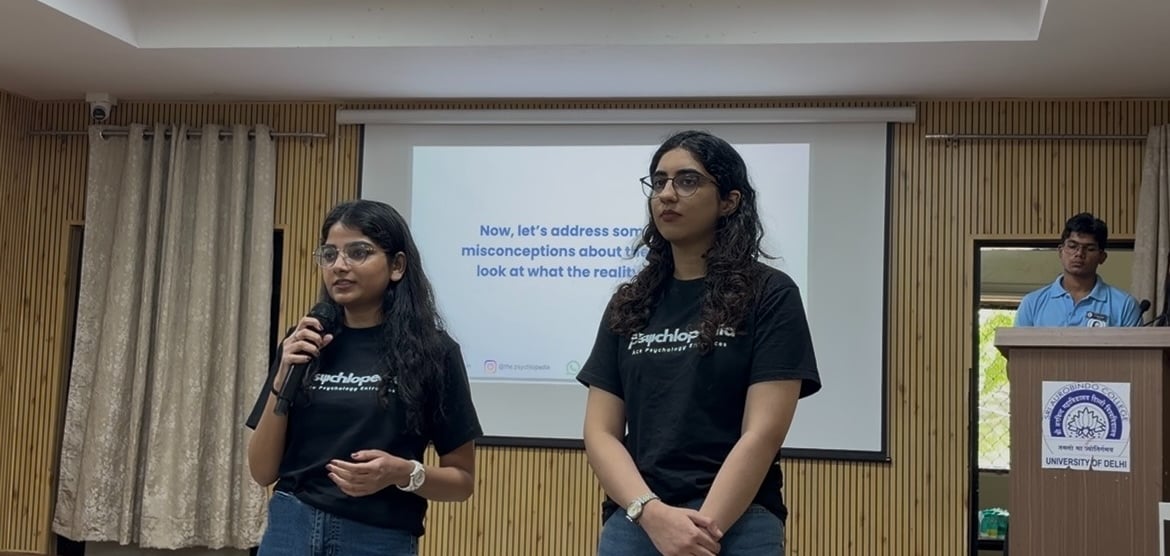
Vidhi Ghai
Manavi Jain
(The one behind all those clear, easy-to-understand, engaging notes and mock tests)
Hi, I’m Manavi
I’m currently a Master’s student at Delhi University and will be completing my degree this month. For the Essentials Series and our preparation courses like CUET PG Psychology, I mainly work on notes, study material, and mock tests. The notes you’ll be using are not from a single source. They’ve been built over time through self-reading, multiple textbooks, and continuous effort to bring everything together in a way that actually makes sense for entrances. When it comes to mock tests, I design each question carefully so you’re exposed to all levels of difficulty, not just surface-level questions.
I strongly believe that the more simple, clear, and interesting the material feels, the more you’ll naturally want to come back to it. You shouldn’t feel like you’re forcing yourself to study, you should feel like you understand what you’re reading. That’s the approach I follow while creating everything for this series, and I hope these resources are helping you in your preparation.
Hi, I’m Vidhi
I have completed my MSc in Counselling Psychology from Christ University, Bangalore, and qualified UGC NET and GATE. In the Essentials Series, I mainly take the live classes and focus on helping you understand concepts in a way that stays with you. I’ve been teaching for the past 4 years, and I’ve consistently seen that students don’t struggle because they aren’t working hard, but because concepts are not taught in a clear, relatable, and applicable way.
That’s what I aim to change in my sessions. My goal is to make classes interesting, engaging, and easy to follow, so you don’t just memorize but actually understand. In entrance exams, especially with indirect or tricky questions, conceptual clarity is what really helps you solve them. That’s the goal I bring into this series and our CUET PG 2027 preparation course as well. As once your concepts are clear, solving MCQs stops feeling stressful and starts feeling logical.


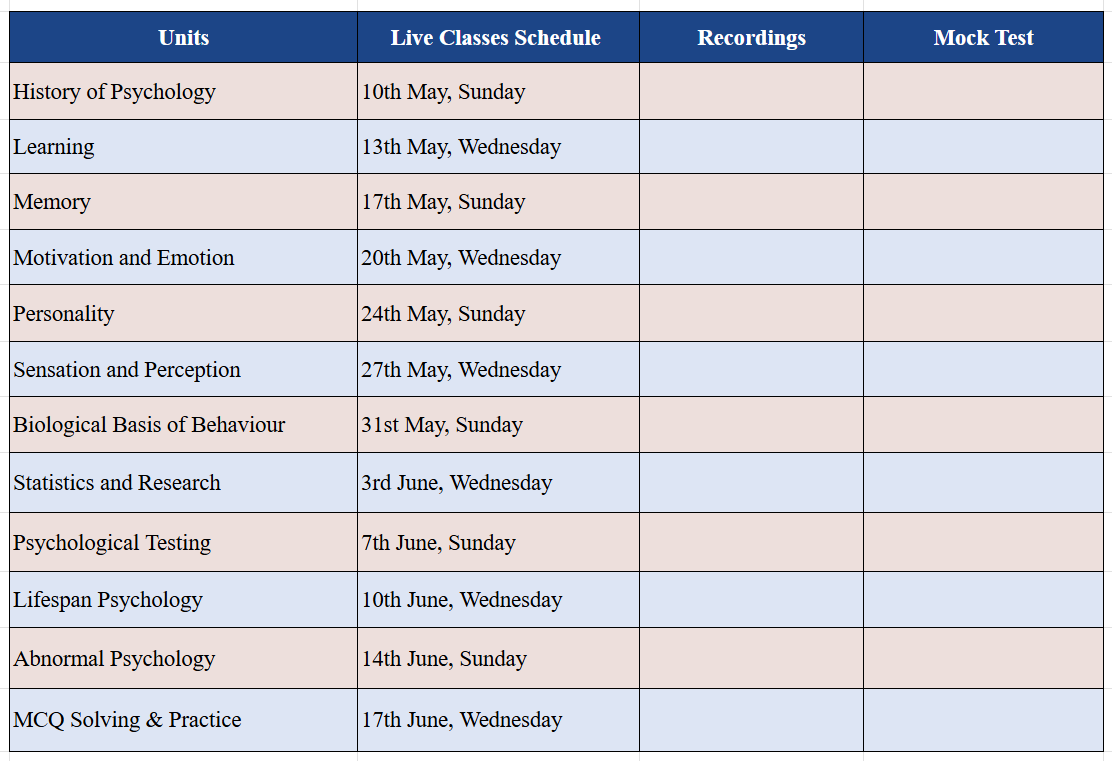
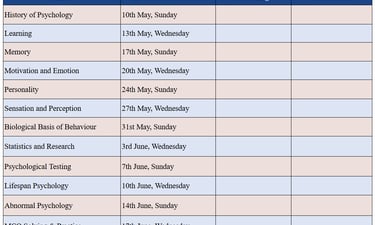
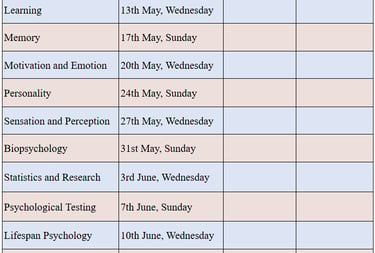
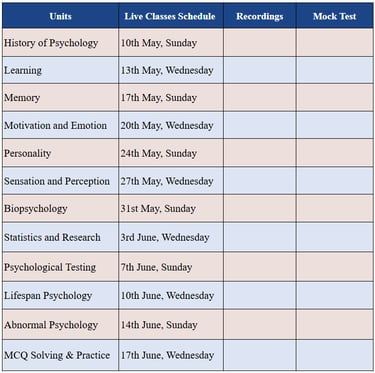
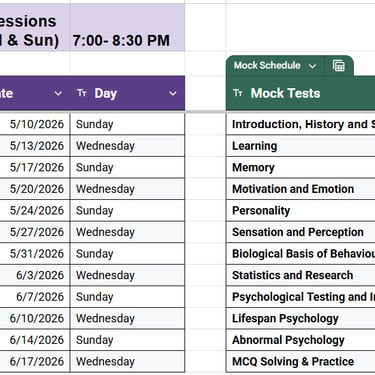
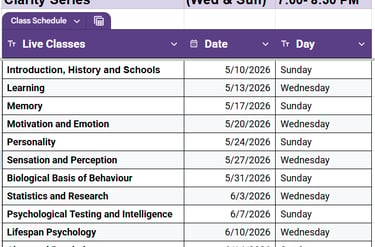
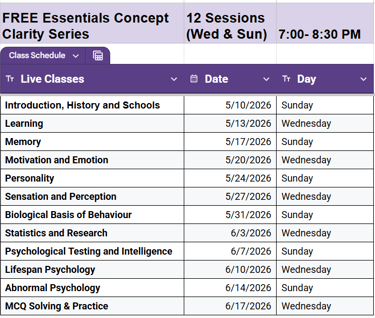
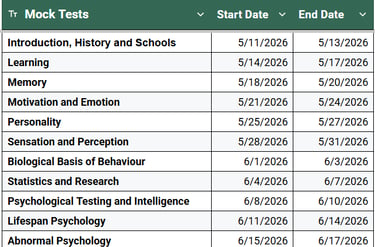
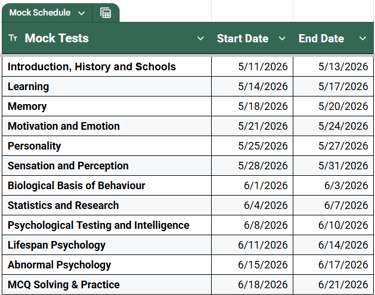
Essentials Series: Classes and Mock Test Schedule
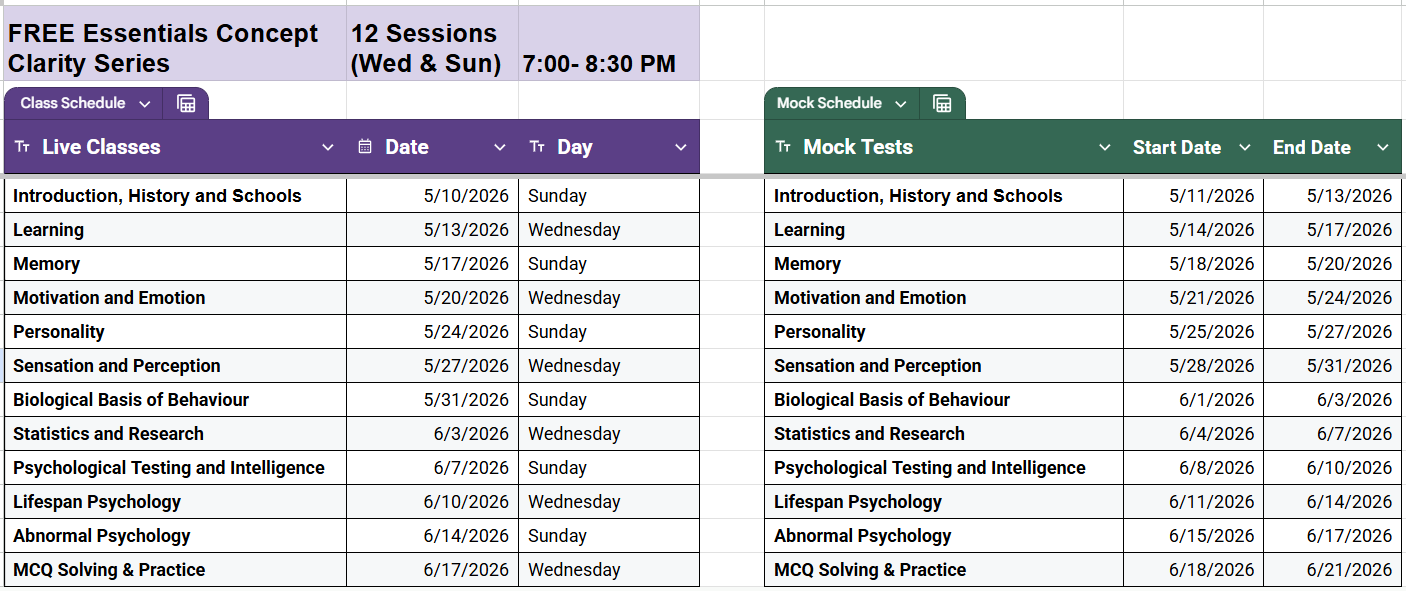
Attending these classes will feel very different from the usual “read the slide and explain the definition” type of lecture.
It will feel like finally understanding the why behind concepts you have been memorizing for years.
Like sitting in a class where every few minutes you catch yourself thinking: “Oh, so that is why this actually happens.”
You will start noticing that you are:
connecting theories with real life automatically
understanding how examiners frame tricky MCQs
predicting answer options before they appear
remembering concepts without forcing yourself to cram
The sessions are highly interactive and thought-driven. Instead of passively writing notes, you will constantly be:
thinking, applying, answering, connecting ideas, and noticing patterns.
There will be moments where:
a difficult topic suddenly feels simple
an old confusion finally gets cleared
a small example or mnemonic makes something impossible to forget
Because concepts are linked with stories, pop culture, daily life observations, and actual exam logic, the classes feel less like studying and more like something you genuinely understand.
You will not leave feeling mentally exhausted from memorizing information.
You will leave feeling:
clearer, more confident, intellectually engaged, and actually ready to solve MCQs.
What These Classes Will Actually Feel Like
Our Approach
At Psychlopedia, we do not treat psychology as something to be memorized mechanically.
We believe that if a concept is taught well, you should be able to understand it, connect it, and remember it without forcing it.
That is why our approach focuses on conceptual clarity over rote learning.
Instead of just giving definitions, we break every concept down step by step so you clearly understand:
why the theory exists
what it actually means
where students usually get confused
how questions are framed in entrances
how to apply it in MCQs
Our classes are designed to be engaging, interactive, and thought-driven, not passive.
We use real-life examples, stories, pop culture references, visual memory cues, mnemonics, diagrams, and application-based thinking
Because psychology is an applied subject, and the best way to learn it is by seeing it in everyday life.
Along with concepts, we also focus strongly on:
exam patterns
MCQ-solving logic
elimination techniques
developing an examiner’s perspective
The goal is not just to help you finish the syllabus.
The goal is to reach a point where even unfamiliar questions feel manageable because your concepts are strong.
That is the difference between memorizing psychology and actually understanding it.
What You’ll Gain From This Series
This is not the kind of series where you attend classes, make notes, and forget everything a few days later. The Essentials Series is designed to build real conceptual depth along with clear entrance-oriented application.
Across 12 live interactive sessions, we focus on the most important and commonly asked topics in psychology, but more importantly, we go beyond surface-level explanations. Each concept is taught with its logic, typical confusion areas, and the way examiners actually frame questions from it. You are not just listening, you are constantly thinking, applying, and engaging with the material.
A major part of the learning happens through live MCQ practice during sessions, followed by application-based questions that train you to approach problems analytically rather than memorizing mechanically. Regular doubt solving ensures that confusion does not accumulate over time.
Along with this, you get carefully curated PPTs and study material, built from standard reference sources and refined through years of teaching experience. Concepts are reinforced using mnemonics, memory techniques, real-life examples, and pop culture references, so they stay with you without forced cramming.
To make sure your preparation aligns with actual exam demands, the series also includes computer-based mock tests and performance analysis, helping you identify weak areas, track improvement, and understand how you compare with others.
Over time, you also start developing a clear sense of how entrance exams think and what separates a strong attempt from an average one.
By the end, the shift is not just in your scores, but in how you see the subject itself. Psychology starts to feel connected, intuitive, and logical, rather than a set of isolated theories to memorize.
This series covers important topics, but if you’re looking for complete syllabus coverage and A to Z preparation for your Master’s entrance exams, you can explore our full course here.
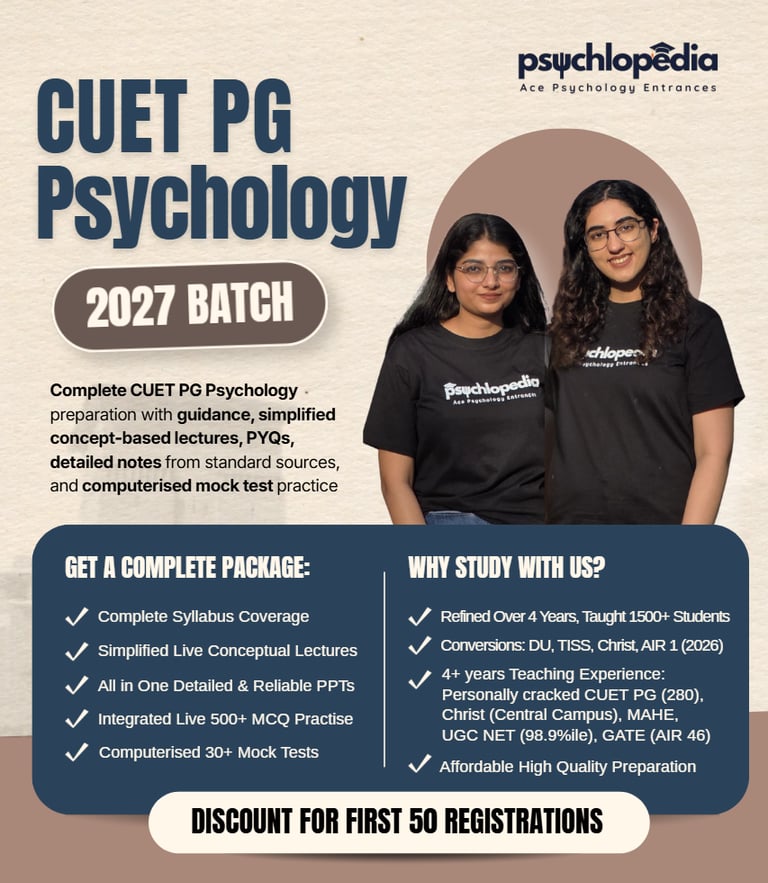
Complete CUET PG & Masters Entrance Preparation 2027 batch
(CUET PG, TISS, Christ, MAHE, NFSU, JMI, Xavier's & other universities with similar syllabus patterns)
Complete preparation (full syllabus coverage)
Simplified, concept-focused lectures
Detailed notes from multiple standard sources
Updated Study Material for 2027 Entrance and cheat sheets
Extensive PYQs with exam-oriented approach
Subject-wise + full-length mock tests
Mocks across all levels: easy, moderate, and difficult
30+ Full-Length Mocks on our E-Portal with timed, auto-evaluated mocks
MCQ-focused practice (main exam requirement)
500+ Live MCQ Solving Revision Classes
Regular practice to strengthen accuracy and speed
Support & guidance throughout the preparation journey